




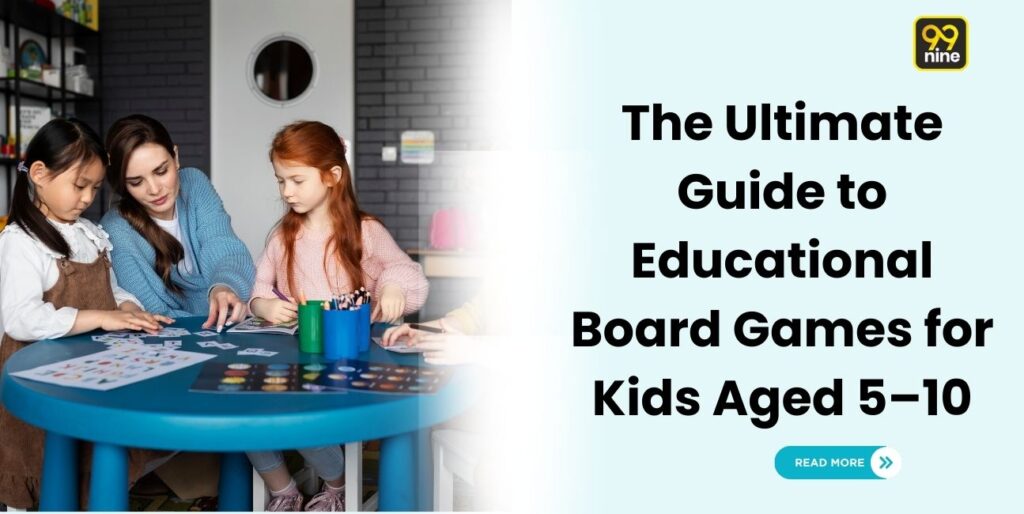
In a world increasingly dominated by digital distractions, parents are constantly searching for ways to pull their children away from tablets and back to the dining table. Have you ever wondered if a simple cardboard box could hold the key to your child’s cognitive development? The answer is a resounding yes. Educational board games for kids have evolved far beyond the repetitive dice-rolling of the past. Today, they are sophisticated tools that blend critical thinking with pure entertainment.
As an experienced educator and content specialist with over two decades of experience, I have seen firsthand how learning board games for children can transform a rainy afternoon into a high-stakes lesson in logic and empathy. For families in India, where academic competition is fierce, these tools offer a necessary reprieve—a way to learn without the pressure of a textbook.
But with thousands of options available, how do you choose the right educational board games for kids to ensure your investment pays off in both fun and brainpower?
Why Strategy Over Screen-Time Matters
The science of play is undeniable. When children engage with learning board games for children, they aren’t just moving plastic tokens; they are activating the frontal lobe of the brain. This area is responsible for executive functions like planning, organizing, and making decisions.
Consider the “Check the Fridge” game or “Prime Climb.” These aren’t just activities; they are educational board games for kids that turn complex mathematical concepts like factorization and prime numbers into a competitive sport. By the time a 7-year-old realizes they are doing mental math, they’ve already won the game.
Does your child struggle with patience? Board games are perhaps the best teachers of “delayed gratification.” Waiting for a turn in a group of four is a real-world social skill that a solo video game simply cannot replicate.
Mathematics and Logic: Building a Strong Foundation
Math anxiety is a common hurdle for many students aged 5–10. However, educational board games for kids can demystify numbers.
- For the 5-7 Age Group: Focus on games that involve simple counting and basic addition. Games like “Snakes and Ladders” (a staple in Indian households) or “Monopoly Junior” are excellent learning board games for children to start understanding currency and movement.
- For the 8-10 Age Group: This is the era of strategy. Games like “Ticket to Ride” or “Catan Junior” require players to manage resources and plan several steps ahead. These are the best educational board games for kids who need to sharpen their logical reasoning.
At 99nine Store, we see parents frequently choosing these tactile experiences to help their kids grasp the “value of a Rupee.” When a child has to decide whether to buy a property or save their cash, they are practicing real-world financial literacy.
Language and Literacy: More Than Just Spelling
Vocabulary building doesn’t have to happen via rote memorization. Many educational board games for kids focus on linguistic dexterity. “Scrabble Junior” and “Wordit” allow children to experiment with letter combinations in a low-stakes environment.
Learning board games for children that involve storytelling or “Guess in 10” style trivia help improve sentence structure and descriptive capabilities. In a bilingual country like India, these games can be instrumental in helping children transition between languages, building a bridge between their native tongue and English proficiency.
Pro Tip: If your child is a “reluctant reader,” try games that require reading action cards. The desire to win often overcomes the hesitation to read!
STEM Board Games for Kids: The New Frontier
The push for STEM (Science, Technology, Engineering, and Math) education has found its way onto the game board. STEM board games for kids like “Newton’s Tree” or “Robot Turtles” teach physics and coding logic respectively.
In these scenarios, the game board acts as a laboratory. Children learn through trial and error—the very essence of the scientific method. When a child plays educational board games for kids centered on STEM, they learn that failure is just a data point, not a dead end. This resilience is what separates a good student from a great innovator.
Social-Emotional Learning (SEL) Through Play
We often focus on the “hard” skills, but what about empathy? Learning board games for children are fantastic for social-emotional growth.
- Conflict Resolution: What happens when two players want the same spot on the board?
- Grace in Defeat: How does a child handle losing to a sibling?
- Teamwork: Cooperative games where everyone wins or loses together.
Using educational board games for kids to teach these “soft” skills is far more effective than a lecture. It provides a safe space for emotional outbursts to be managed and discussed in real-time.
Selecting the Right Games for Your Child
When looking to buy educational board games online, it’s easy to get overwhelmed. To make the best choice, consider the “Three-Layer Test”:
| Layer | Question to Ask | Why it Matters |
| Engagement | Is the game actually fun, or is it a “worksheet in a box”? | If it’s not fun, they won’t play it twice. |
| Duration | Can a 6-year-old stay focused for the 45-minute playtime? | Match the game length to their attention span. |
| Scalability | Can the rules be simplified or made more complex? | This ensures the game “grows” with the child. |
If you are looking for educational board games India specifically, look for brands that incorporate local themes or simplified mechanics for younger players. Stores like 99nine Store offer a curated selection of kids brain development board games that hit all these marks without breaking the bank.
Practical Tips for a Successful Game Night
To truly leverage educational board games for kids, you need a plan. You can’t just drop a box on the table and expect magic.
- Be a Player, Not a Teacher: Your child wants to play with you, not be tutored by you. Focus on the fun, and the learning will follow naturally.
- The “One Rule” Introduction: Don’t read the entire rulebook aloud. Explain the basic goal and one rule, then start playing. Teach the rest as you go.
- Create a Play Nook: Dedicate a specific area for these learning board games for children. When the environment is right, the focus follows.
- Rotate Your Stock: Don’t leave all the games out at once. Keep a few hidden and rotate them every month to keep the excitement fresh.
Visualizing Success: The Growth Infographic
Imagine a diagram showing a child’s brain. One side represents “The Classroom” (linear, structured, often passive). The other side represents “Educational Board Games for Kids” (multi-directional, interactive, active). The center of the diagram is where “Permanent Knowledge” lives. This is the power of tactile play.
Conclusion: Investing in the Future of Play
In the grand scheme of things, the time we spend playing with our children is fleeting. By choosing educational board games for kids, you aren’t just buying a toy; you are investing in their cognitive flexibility and your family’s bond. These learning board games for children bridge the gap between “having to learn” and “wanting to know.”
Whether you are looking for educational board games for preschoolers or more complex educational board games for 5–10 year olds, the goal remains the same: to spark curiosity.
Ready to transform your family evenings? Visit [https://www.99ninestore.com/] today to explore our curated collection of affordable, high-quality educational board games for kids. Let’s make learning the highlight of your child’s day!